Tim Sweeney Called UnrealScript His Baby, Then Retired It. Blueprints Never Stood a Chance.
Epic's founder has spent 35 years building tools so anyone can make games, then replacing them with tidier ones. Now AI may finally carry everyone into the language he has wanted since 2006, and Bluesky has a riddle for him.

In 1991, working out of his parents' house in Potomac, Maryland, an engineering student named Tim Sweeney turned a text editor into a game called ZZT and shipped it with a tiny scripting language so players could build worlds of their own. Several billion dollars later, Sweeney keeps the same tender, slightly ruthless relationship with his tools: he adores each one until he has designed a tidier one.
Exhibit A is UnrealScript, which he wrote himself. "That was my baby there," he told Gamasutra in 2014, while explaining the huge dividends of retiring it. Blueprints, the drag-the-wires system that let artists script without code, was the consolation gift at that funeral, and now it gets one of its own. At Unreal Fest Tokyo on November 3 Sweeney called its removal from Unreal Engine 6 painful and apologized, Inven Global reported. Then Epic said Blueprints would skip even early access, because AI could convert old projects.
Bluesky took the news personally, a backhanded compliment in itself. Brian Bucklew, co-creator of Caves of Qud, posted the cleanest form of the suspicion: "if AI coding works as well as it's supposed to why do they even care if blueprints is or isn't in UE6?" Fourteen seconds later he added "riddle me this, batman," in the voice of someone who already suspects the answer.
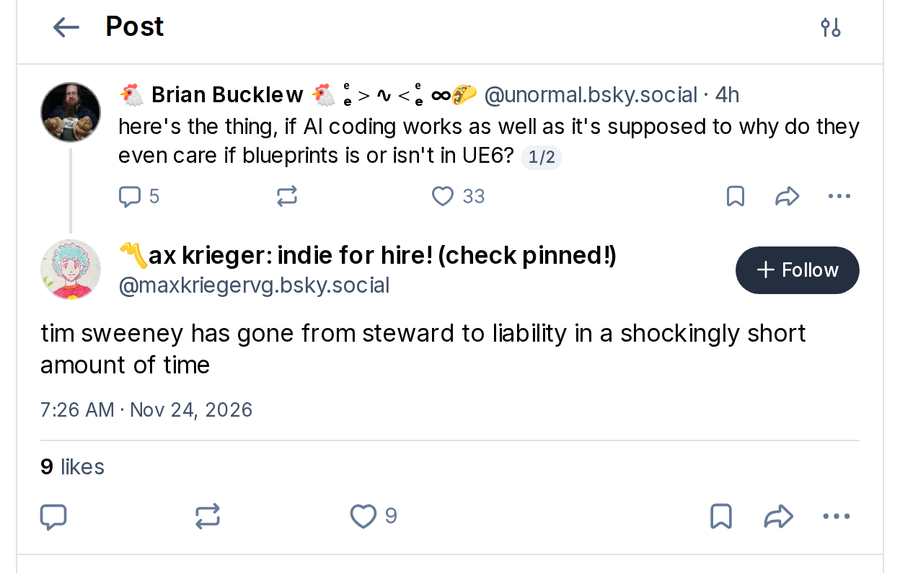
Under it, another developer delivered the verdict: "tim sweeney has gone from steward to liability in a shockingly short amount of time." Elsewhere he was "delusional" and the decision "a power move." Steward is the revealing word, the kind reserved for someone minding the place on your behalf, and Sweeney earned it through years of picking fights with Apple and Steam in developers' names. The hurt is not really about a feature; it is the discovery that the man guarding the commons has firm private opinions about the furniture.
Bucklew's riddle has at least three answers. The mischievous one is about data. Every studio that converts adds to the world's supply of Verse, Epic's own language. Sweeney himself noted on X that leading AI models "saw little Verse organically during training, but that will change by January," which makes a mass migration sound delightfully like a syllabus. The anxious answer starts in October, when he announced a huge pivot toward "maximum AI acceleration" and called his "more modest aim" surviving the AI revolution. That is a startling line from a billionaire, and perhaps the honest voice of someone who once was the entire company.
The smart money, though, is on romance. In 2006 he lectured language researchers on "The Next Mainstream Programming Language," and by 2023 his name sat beside Simon Peyton Jones's on the paper defining Verse's core calculus. Blueprints were never competing with a product so much as with a two-decade crush, and AI is the first crane strong enough to lift an industry's back catalog into Verse at once. The reading may flatter him, and the lock-in works either way, but it fits a man who built the editor before the game.

Somewhere behind the keynotes lives the student in Potomac who made a game mostly so other people could make games. He still wants exactly that. He would simply prefer they do it in Verse.
Sources
- Wikipedia contributors, Wikipedia, “ZZT”
- Wikipedia contributors, Wikipedia, “Epic Games”
- Christian Nutt, Game Developer (then Gamasutra), “Epic's Tim Sweeney lays out the case for Unreal Engine 4”, 2014-03-21
- John Popko, Inven Global, “Epic Games will remove Blueprints and Actors from Unreal Engine 6”, 2026-11-03
- Chris Kerr, Vertical Slice, “Epic is ditching Blueprints earlier than expected, says devs can use generative AI to convert projects to UE6”, 2026-11-24
- Sam Chandler, Shacknews, “Tim Sweeney says Epic Games 'aims to survive AI revolution' with AI pivot”, 2026-10-12
- Tim Sweeney, ACM SIGPLAN-SIGACT POPL '06, “The Next Mainstream Programming Language: A Game Developer's Perspective”, 2006-01-11
- Lennart Augustsson, Joachim Breitner, Koen Claessen, Ranjit Jhala, Simon Peyton Jones, Olin Shivers, Tim Sweeney, ICFP 2023 (via simon.peytonjones.org), “The Verse Calculus: a core calculus for deterministic functional logic programming”, 2023-07-01
Public reaction (not independent confirmation)
- Brian Bucklew (@unormal.bsky.social), Bluesky, “Post: why do they even care if Blueprints is in UE6 (and reply: riddle me this, batman)”, 2026-11-24
- @maxkriegervg.bsky.social, Bluesky, “Post: steward to liability”, 2026-11-24
- @papermartin.bsky.social, Bluesky, “Post: tim sweeney is just delusional”, 2026-11-23
- @velstrak.bsky.social, Bluesky, “Post: a power move by Tim Sweeney”, 2026-11-24